

Pablo Debenedetti, Athanassios Panagiotopoulos, and Jeroen Tromp use molecular simulations to provide new insights into processes relevant to CO2 storage and climate.
Ice and hydrate nucleation
The Debenedetti Group is using advanced molecular simulation techniques to study the rates and mechanisms of formation of ordered phases of water, including ice and gas hydrates. Studying ice nucleation at atmospherically-relevant conditions is of interest to atmospheric and environmental sciences and can be pivotal in developing more accurate predictive tools for weather forecasting, as well as for improving fundamental understanding of climate change. Studying nucleation and stability of hydrates is relevant to CO2 capture and storage, as well as to climate change-induced release of CH4.
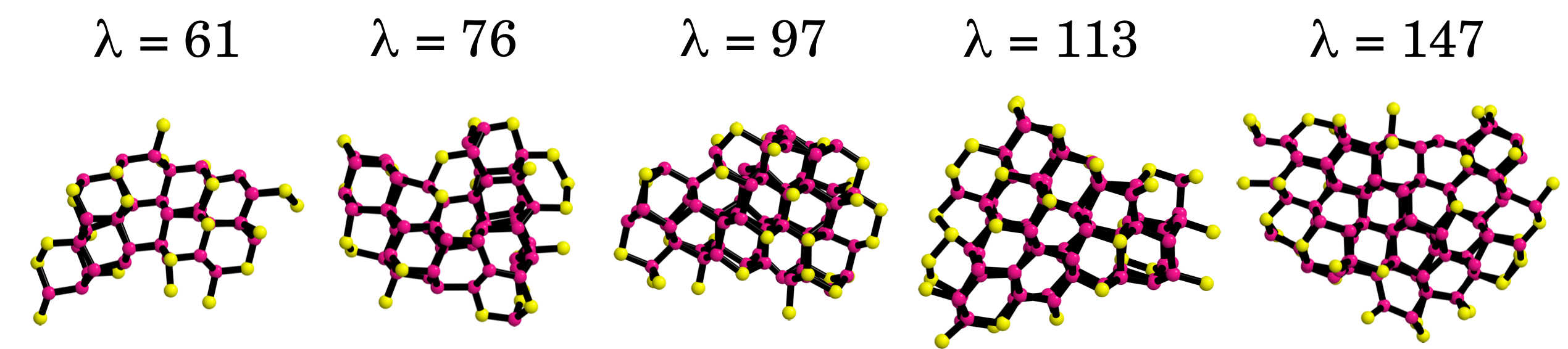
In 2013, Debenedetti and colleagues developed an advanced sampling technique for computing nucleation rates in slowly relaxing systems, and began using it to compute the rate of ice nucleation in molecular models of water. Due to the extremely slow structural relaxation in such systems, existing techniques are unsuccessful in computing the rate of ice nucleation. With a new algorithm, based on molecular dynamics and a coarse-grained version of the forward-flux sampling (FFS) technique, they have obtained a statistically representative picture of the nucleation process. Calculations are still in progress, but the results to date give the team confidence in the eventual success of this approach. Figure 6 depicts ice crystallites of different sizes obtained from the algorithm.
The researchers are also continuing work on molecular modeling of CO2-brine systems of relevance to CO2 storage. In the coming year they expect to publish the ice nucleation calculations, and to apply the method to heterogeneous ice nucleation and to nucleation of hydrates.