
Principal Investigator

At a Glance
The ongoing increase in atmospheric carbon dioxide (CO2) acidifies the surface ocean. The Morel group has documented highly significant effects of ocean acidification on the bioavailability of essential trace metals such as iron and zinc, which are known to limit the growth of phytoplankton and, hence, the productivity of ecosystems in large areas of the oceans. A newly developed electrochemical analytical method is the first to show a quantitative correspondence between metal “lability” and rates of biological uptake in natural seawater.
Research Highlight
The acidification (i.e., decreasing pH) of the surface ocean modifies its chemistry and, potentially, the bioavailability of nutrients. The Morel group has conducted both field and laboratory experiments to examine how the bioavailability of essential trace metals to phytoplankton changes over the range of pH values expected to occur in surface seawater over the next century.
The availability of trace metals to marine microorganisms depends on the extent to which they are bound to organic compounds, which in turn depends on ocean acidity. By increasing the organic binding of iron, ocean acidification decreases the bioavailability of one of the most important limiting nutrients in the oceans. For zinc, a metal that affects the assemblage of phytoplankton species that fuel marine food webs, the opposite result—an increase in bioavailability upon acidification—is expected and generally observed. Sometimes, however, a decrease in zinc bioavailability can result from competitive metal binding among organic compounds.
In laboratory experiments, a decrease in pH modified the bioavailability of iron and zinc in a way that was quantitatively consistent with the calculated change in their binding by the weak and strong organic complexing agents in the experimental medium. Extending these results to natural seawater is difficult, however, due to the presence of myriad organic compounds of unknown chemistry and affinity for the metals of interest.
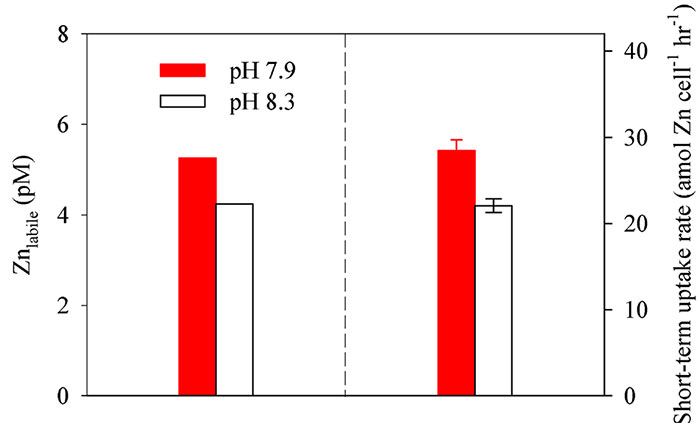
To overcome this difficulty, the Morel group developed an electrochemical method to quantify the effects of acidification on metal availability in natural seawater in the presence of unknown metal-binding compounds. The new method distinguishes between the metal species available for biological uptake by phytoplankton and those that are not. These results will enable future assessments and predictions of how increases in CO2 concentration impact marine ecosystems.
The simplicity of the figure that illustrates these results (Figure 1.3.) belies their novelty and importance: it is the first time that a quantitative correspondence has been shown between chemical measurements of metal “lability” and rates of biological uptake in natural water samples.
References
Goldman, J.A.L., M.L. Bender, F.M.M. Morel, 2017. The effects of pH and pCO2 on photosynthesis and respiration in the diatom Thalassiosira weissflogii. Photosynth. Res., in press.
Hong, H., R. Shen, F. Zhang, Z. Wen, S. Chang, W.F. Lin, S.A. Kranz, Y.W. Luo, S.J. Kao, F.M.M. Morel, and D. Shi, 2017. The complex effects of ocean acidification on the dominant N2-fixing cyanobacterium Trichodesmium. Science, in review.