

Principal Investigator

At a Glance
In order to have a significant impact on the carbon problem, very large amounts of captured carbon dioxide (CO2) need to be injected underground, with quantities reaching gigatonnes of CO2 per year by mid-century. The Celia group has developed models for large-scale injection, including pressure responses and associated pressure management schemes, and applied these to realistic injection scenarios in the Illinois Basin of North America, with simulated basin-wide injection rates exceeding 200 Mt CO2/yr. Results indicate that if carbon capture and storage is to be implemented at the scale required to impact the carbon problem, such basin-wide analyses will need to be performed and appropriate management of pressure developed and implemented.
Research Highlight
The capture and belowground storage of carbon dioxide emissions from power plants and other sources has the potential to mitigate climate change by preventing the release of these emissions into the atmosphere. In order to have any significant impact on the carbon problem, very large amounts of captured CO2 need to be injected underground, with quantities reaching gigatonnes of CO2 per year by mid-century. This will require tens to hundreds of millions of tonnes of CO2 to be injected into a given sedimentary basin.
Earlier research by the Celia group, and others, led to the idea that very large-scale injection of CO2 may need to be coupled with brine production and other measures to control pressure buildup in the injection formations.1-11 To illustrate the impacts of very large-scale injection, a new study simulates pressure buildup in the Illinois Basin associated with injection of CO2 into the Mount Simon Formation. Figure 2.1.1. shows the increase of pressure associated with injection of close to 200 Mt CO2/yr, assuming 54 different on-site injection locations, and using a computational model that includes 11 geological layers and covers approximately 300,000 km2.
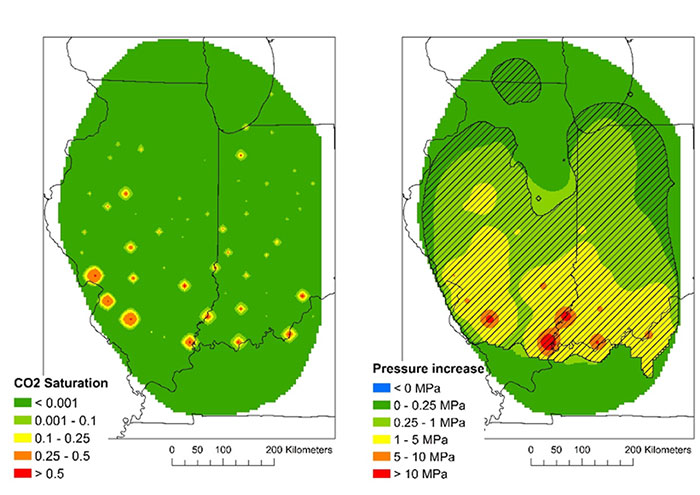
The Area of Review (AoR) is defined as the area where, by EPA regulation, pressure increase is sufficient to require site characterization and monitoring. The total AoR for this injection scenario is close to 200,000 km2. Not only is this a large area, but many of the individual injection sites have AoRs that overlap with those from neighboring injection sites, thereby complicating the determination of responsible parties in the event of a leakage event or other problem. In addition, the large pressure build-up has a number of associated risks including possible leakage of brines from the injection formation to shallow drinking water aquifers (this is the basis of the EPA definition for AoR) as well as increased potential for induced seismicity.
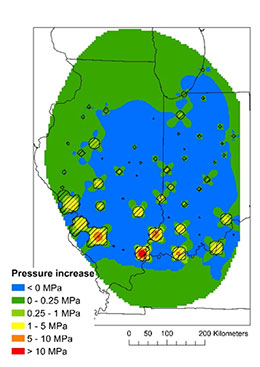
One way to reduce pressure build-up, and thereby the AoR, is through the use of brine production wells. Such wells need to be close enough to the injection to have an impact on the pressure response, but far enough away to avoid any early CO2 breakthrough. If the volume of brine extracted matches the volume of CO2 injected, then the pressure responses associated with each injection well can be controlled and the pressure build-up is highly localized. A strategy of 100% volume matching reduces the overall AoR from around 200,000 km2 to less than 20,000 km2 while eliminating overlapping AoRs (Figure 2.1.2.).
Production of brine carries its own set of challenges, however, related to the use and disposal of the brines. While earlier collaborative work with Lawrence Livermore National Laboratory5,6,10 studied the possible use of heat from produced waters as well as desalination options, these utilization options appear to be limited in the Illinois Basin due to the relatively low temperatures and high salinities. Therefore disposal of the produced water becomes an issue. We have considered reinjection of the produced brines into formations above the injection formation (that is, above the Mount Simon Formation), with fractions ranging from 25% to 100% of the extracted water. In these cases, pressure increases in the overlying formations need to be analyzed and potential AoRs need to be computed for those injection operations.
Also, as in our earlier analysis of the Basal Sandstone formation in western Canada13, we considered off-site injection at regional centers, as opposed to on-site injections. This requires pipelines to transport the CO2 to the best locations for injection, but the result is a smaller and more easily managed pressure response. Even without brine extraction, this strategy reduces the overall AoR by about 30%. Adding brine extraction then allows for much larger reductions in AoR values, similar to the on-site results. The use of regional centers chosen for optimal injection properties also solves the problem of excessive pressure buildup at injection locations where subsurface properties are not conducive to large-scale injection, which happens at several of the on-site locations, affecting approximately 25% of the total CO2 injected.
Overall, if carbon capture and storage is to be implemented at the scale required to impact the carbon problem, these kinds of basin-wide analyses will need to be performed and appropriate management of pressure developed and implemented.
References
1 Bandilla, K. W., M.A. Celia, T.R. Elliot, M. Person, K.M. Ellett, J.A. Rupp, C. Gable, and Y. Zhang, 2012. Modeling carbon sequestration in the Illinois Basin using a vertically-integrated approach. Comput. Visual Sci., 15(1): 39-51. doi:10.1007/s00791-013-0195-2.
2 Birkholzer, J. T., A. Cihan, and Q.L. Zhou, 2012. Impact-driven pressure management via targeted brine extraction—Conceptual studies of CO2 storage in saline formations. Int. J. Greenh. Gas Con., 7: 168-180. doi:10.1016/j.ijggc.2012.01.001.
3 Bourcier, W.L., T.J. Wolery, T. Wolfe, C. Haussmann, T.A. Buscheck, and R.D. Aines, 2011. A preliminary cost and engineering estimate for desalinating produced formation water associated with carbon dioxide capture and storage. Int. J. Greenh. Gas Con., 5(5): 1319-1328. doi:10.1016/j. ijggc.2011.06.001.
4 Buscheck, T.A., J.M. Bielicki, M.J. Chen, Y.W. Sun, Y. Hao, T.A. Edmunds, M.O. Saar, and J.B. Randolph, 2014. Integrating CO2 Storage with Geothermal Resources for Dispatchable Renewable Electricity. Enrgy. Proced., 63: 7619-7630. doi:10.1016/j.egypro.2014.11.796.
5 Buscheck, T. A., T.R. Elliot, M.A. Celia, M.J. Chen, Y.W. Sun, Y. Hao, C. Lu, T.J. Wolery, and R.D. Aines, 2013. Integrated geothermal-CO2 reservoir systems: Reducing carbon intensity through sustainable energy production and secure CO2 storage. Enrgy. Proced., 37: 6587-6594. doi:10.1016/j. egypro.2013.06.591.
6 Buscheck, T. A., Y.W. Sun, M.J. Chen, Y. Hao, T.J. Wolery, W.L. Bourcier, B. Court, M.A. Celia, S.J. Friedmann, and R.D. Aines, 2012. Active CO2 reservoir management for carbon storage: Analysis of operational strategies to relieve pressure buildup and improve injectivity. Int. J. Greenh. Gas Con., 6: 230-245. doi:10.1016/j.ijggc.2011.11.007.
7 Buscheck, T. A., Y.W. Sun, Y. Hao, T.J. Wolery, W. Bourcier, A.F.B. Tompson, E.D. Jones, S.J. Friedmann, and R.D. Aines, 2011. Combining brine extraction, desalination, and residual-brine reinjection with CO2 storage in saline formations: Implications for pressure management, capacity, and risk mitigation. Enrgy. Proced., 4: 4283-4290. doi:10.1016/j.egypro.2011.02.378.
8 Buscheck, T. A., J.A. White, S.A. Carroll, J.M. Bielicki, and R.D. Aines, 2016. Managing geologic CO2 storage with pre-injection brine production: a strategy evaluated with a model of CO2 injection at Snøhvit. Energy Environ. Sci., 9(4): 1504-1512. doi: 10.1039/C5EE03648H.
9 Cihan, A., J. Birkholzer, and M. Bianchi, 2014. Targeted Pressure Management during CO2 Sequestration: Optimization of Well Placement and Brine Extraction. Enrgy. Proced., 63: 5325-5332. doi:10.1016/j.egypro.2014.11.564.
10 Court, B., K.W. Bandilla, M.A. Celia, T.A. Buscheck, J.M. Nordbotten, M. Dobossy, and A. Janzen, 2012. Initial evaluation of advantageous synergies associated with simultaneous brine production and CO2 geological sequestration. Int. J. Greenh. Gas Con., 8: 90-100. doi:10.1016/j.ijggc.2011.12.009.
11 Lindeberg, E., J.F. Vuillaume, and A. Ghaderi, 2009. Determination of the CO2 storage capacity of the Utsira formation. Enrgy. Proced., 1(1): 2777-2784. doi:10.1016/j.egypro.2009.02.049.
12 Bandilla, K.W., and M.A. Celia, 2017. Active pressure management through brine production for basin-wide deployment of geologic carbon sequestration. Int. J. Greenh. Gas Con., in review.
13 Huang, X., K.W. Bandilla, M.A. Celia, and S. Bachu, 2014. Basin-scale modeling of CO2 storage using models of varying complexity. Int. J. Greenh. Gas Con., 20: 73-86. doi:10.1016/j.ijggc.2013.11.004.
14 Bandilla, K.W., and M.A. Celia, 2016. Active Pressure Management through Brine Production for Basin-wide Deployment of Geologic Carbon Sequestration. Int. J. Greenh. Gas Con., in review.