
Principal Investigator

At a Glance
Modeling studies suggest that the ocean around Antarctica acts as a key sink for atmospheric carbon dioxide (CO2) and heat, thus mitigating global temperature increases caused by rising levels of CO2. However, ship-based observations needed to understand the processes behind this uptake are scarce in the harsh and remote Southern Ocean, particularly in winter. To combat the data shortage, Jorge Sarmiento is directing the first large-scale deployment of robotic floats equipped with biogeochemical measurement instruments in this region. The project is enabling unprecedented observations of pH, biological productivity, carbon cycling, and phytoplankton dynamics in the Southern Ocean and improving our ability to predict its future.
Research Highlight
CMI member Jorge Sarmiento directs the National Science Foundation-funded Southern Ocean Carbon and Climate Observations and Modeling (SOCCOM) project, a multi-institutional effort to observe the poorly sampled ocean around Antarctica and increase our understanding of how it influences Earth’s climate and carbon cycles. CMI-supported modeling studies have indicated that the Southern Ocean is a large sink for atmospheric heat and carbon, as well as an important source of nutrients for low-latitudes, but efforts to observe the region directly are hampered by rough conditions that limit access by conventional research vessels. SOCCOM scientists are working to dramatically increase the number and variety of observations of the Southern Ocean through the world’s first large-scale deployment of biogeochemical (BGC) Argo floats (Figure 1.2.1.) – robotic floats equipped with newly developed biogeochemical sensors to measure pH, nitrate, and oxygen in addition to ocean temperature and salinity. The new observations are giving an unprecedented view of carbon cycling and biological productivity in this important region, and helping us to understand how these processes might change in the future.
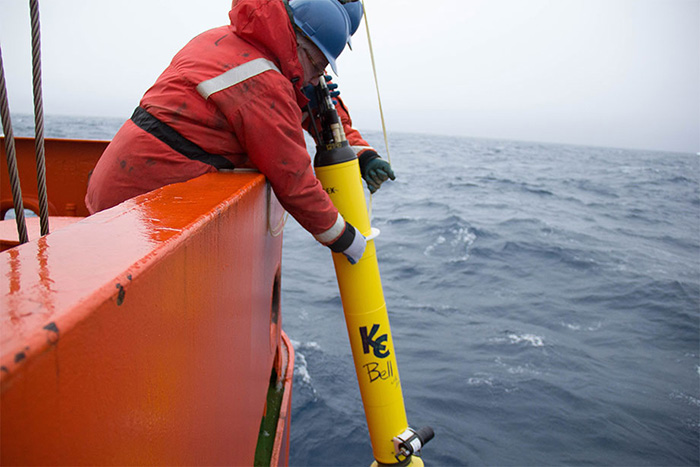
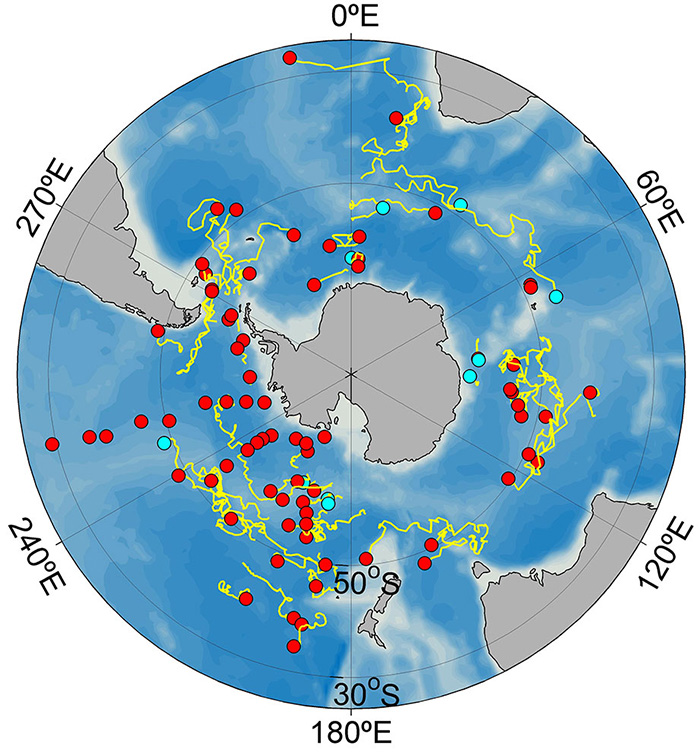
Seventy-seven SOCCOM BGC floats (Figure 1.2.2.) are currently operating and have collectively made over 2 million observations in the Southern Ocean. The SOCCOM float data are made freely available to the public in near-real time, and have been incorporated into the global Argo data system used by hundreds of researchers around the world.
Complementing this observational effort, the SOCCOM team has developed model-based tools to study controls on Southern Ocean biogeochemistry and its response to climate change. To better understand the current workings of the Southern Ocean, SOCCOM researchers have assimilated observational data into an ocean model to produce a 3-D, physically realistic estimate of Southern Ocean biogeochemistry (B-SOSE) that is freely available to the oceanographic community. To improve predictions of future climate and carbon cycle changes, planning has been completed for a Southern Ocean Model Intercomparison Project (SOMIP) that will analyze differences among Earth system model forecasts from leading research groups.
Together, SOCCOM data and tools are providing unparalleled insights into the Southern Ocean. Wintertime and under-ice measurements never before available are yielding information on the annual variability of pH and carbonate saturation in the system, net community production, carbon export, air-sea fluxes of CO2 and O2, and bloom dynamics. For example, analyses of the new data have revealed that seasonal changes in CO2 fluxes and nutrient concentrations are much larger than previously estimated from ship-based data, which is biased toward the summer months. This insight has implications for our understanding of the magnitude, timing, and location of Southern Ocean carbon uptake, and also for model development, as current models of ocean biogeochemistry have been tuned to match the earlier, seasonally-biased estimates of carbon and nutrient distributions. These and other early research results, along with SOCCOM technology and methods, will be shared in a special issue of the Journal of Geophysical Research – Oceans this spring.

SOCCOM will continue to make progress on observational and modeling goals in the coming year. This September will mark the end of the group’s third cruise season, after which over 90 BGC floats will have been deployed, bringing SOCCOM nearly halfway to its goal of 200 floats deployed within six years. This year will also see SOCCOM float data incorporated into the biogeochemical state estimate and the initiation of SOMIP. Beyond SOCCOM, the team is working with international research partners to expand the SOCCOM network of BGC floats and create a global observing system for ocean health.
References
Johnson, K.S., J.N. Plant, L.D. Talley, and J.L. Sarmiento, 2017. Annual nitrate drawdown observed by SOCCOM profiling floats and the relationship to annual net community production. J. Geophys. Res.–Oceans., in review.
Tamsitt, V., H. Drake, A.K. Morrison, L.D. Talley, C.O. Dufour, A.R. Gray, S.M. Griffies, M.R. Mazloff, J.L. Sarmiento, J. Wang, and W. Weijer, 2017. Spiraling up: pathways of global deep waters to the surface of the Southern Ocean. Nat. Comm., in review.
Williams, N. L., L.W. Juranek, R.A Feely, K.S. Johnson, J.L. Sarmiento, L.D. Talley, A.G. Dickson, A.R. Gray, R. Wanninkhof, J.L. Russell, and S. C. Riser, 2017. Calculating surface ocean pCO2 from biogeochemical Argo floats equipped with pH: an uncertainty analysis. Global Biogeochem. Cy., in review.