

Principal Investigator

At a Glance
Models project an increase in the rate of “rapid intensification” for tropical cyclones globally by the end of the 21st century. However, projections of changes in hurricane frequency in the Atlantic remain more uncertain, and model simulations and potential undercounts prior to available satellite data suggest observed long-term trends in hurricane counts are data artifact. The goal of this work is to reconcile these potential discrepancies and to improve the understanding of the mechanisms behind and limits to the predictability of tropical cyclone (TC) activity over the past few and next centuries. The work connects to broad questions in the climate science community, such as uncertainty over what TC changes are likely to occur over the coming century, and the extent to which intrinsic climate variability may be dominant over the impact of greenhouse forcing.
Research Highlight
Tropical cyclone intensification. A particular focus of Vecchi’s group has been on projections of rapid intensification of TCs, in which the wind speeds of TCs increase abruptly in less than a day, such as with hurricanes Harvey, Irma, and Maria in 2017. Rapidly intensifying TCs present a particular challenge to society as they tend to be poorly forecast on the weather scale and can leave communities with little time to prepare for impacts. The group recently submitted a manuscript describing climate model projections for a substantial increase in the rate of rapid intensification for TCs globally by the end of the 21st century, which may be evident as soon as the next few decades1.
Hurricane frequency. The team also explored the question of how TC frequency (the number of storms) may change. Modeling studies indicate the potential for both increases and decreases in regional TC frequency over the 21st century – can these diverging projections be distinguished?
Given that greenhouse warming is evident over the past century, answers to two questions can help us interpret the future: How and why has TC activity changed in the past? If a greenhouse-induced change in past TC activity is identified, one could expect it to continue into the future; if natural climate variations were dominant in the past, one may continue to experience substantial fluctuations.
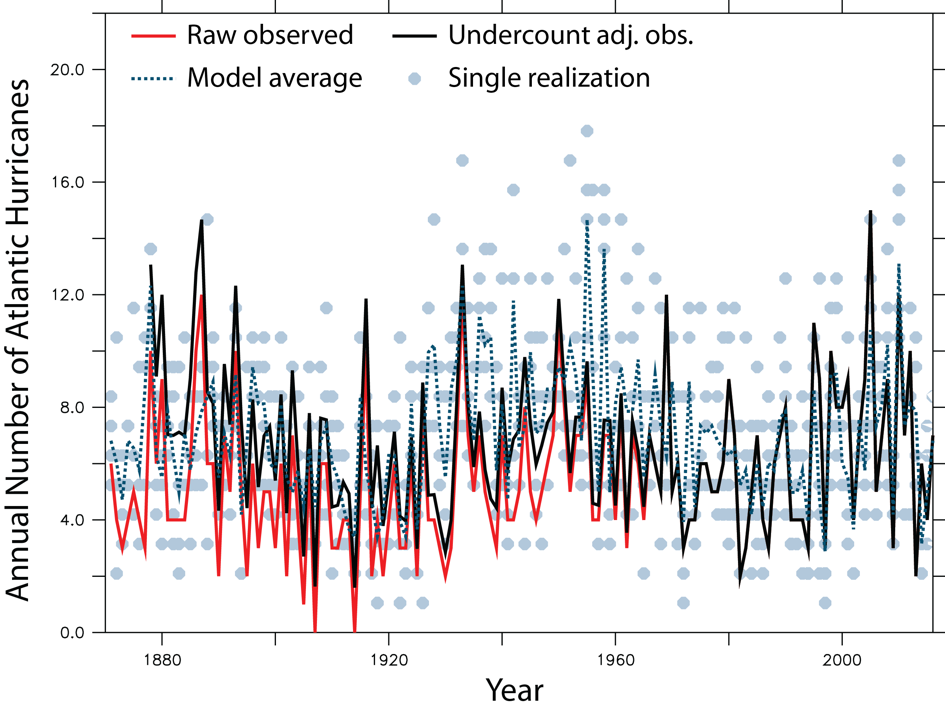
The North Atlantic, where TCs are referred to as hurricanes, has the longest continuous database of TCs, with records available since the mid-1800s. These records indicate strong fluctuations in the number of hurricanes, including a nominal increase in the raw hurricane counts (see red line in Figure 1.2.1). However, potential undercounts prior to available satellite data suggest this long-term trend is a data artifact (compare black and red lines in Figure 1.2.1). Therefore, the group performed a suite of high-resolution climate model experiments (blue line and symbols in Figure 1.2.1). When constrained with estimates of past ocean temperatures, the model is able to recover many aspects of the observed Atlantic hurricane record.
This modeling study does not support the notion of a historical increase in Atlantic hurricane frequency since the late-1800s. Furthermore, these experiments support the hypothesis that official hurricane records have a substantial undercount in the pre-satellite era (Figure 1.2.1). This particular study does not address changes in the most intense hurricanes1, nor of hurricane rainfall. A warmer atmosphere is able to “hold” more moisture so hurricane rainfall is expected to increase with warming; a recent study indicates that the odds of the extreme rainfall over the Houston area during Hurricane Harvey was enhanced by global warming2, and another study indicates these extremes should increase over the coming century3.
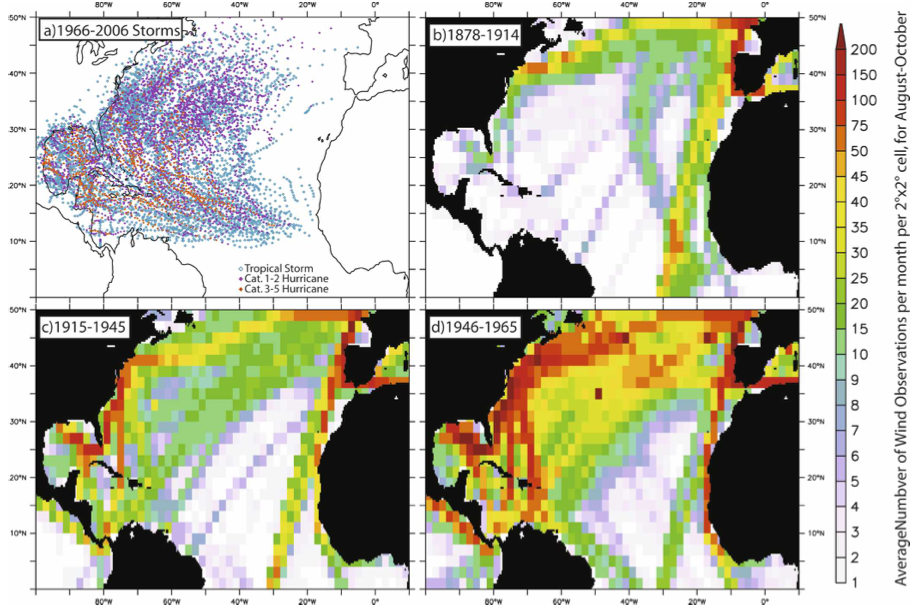
In the coming year, the results from the simulations over the period 1871-2017 will be further analyzed, with a focus on hurricane-induced and regional rainfall. Further, the sensitivity to uncertainties in the knowledge of past ocean temperatures, and the sensitivity of the results to climate model formulation, will be explored by repeating the simulations with different estimates of historical temperature and a different high-resolution climate model. Of particular interest will be the potential discrepancy between model estimates of mid-20th century TC activity and those in historical reconstructions (Figure 1.2.2).
Volcanic activity. The response of TCs to volcanic forcing will also be explored through targeted climate model experiments in order to test the hypothesis that TC sensitivity to volcanoes depends fundamentally on the hemisphere in which the volcanic plume is most pronounced. Preliminary results indicate that El Chichón (1982), whose plume had a northern hemisphere maximum, increased TC activity in the southern hemisphere, and Agung (1963), which had its plume primarily in the southern hemisphere, acted to increase TC activity in the northern hemisphere. Emissions from explosive volcanoes can remain in the stratosphere for years and reduce the amount of sunlight reaching the surface, leading to a cooling of the planet. If the volcanic plume is primarily in one hemisphere, one would expect the cooling to be concentrated in that hemisphere, and the hypothesis of “relative warming” control on TC activity and rainfall6,7 suggests a more favorable environment for TCs and rainfall in the opposite hemisphere.
These experiments will also be used to understand the sensitivity of rainfall (and its extremes) beyond volcanic forcing, including the extent to which the impact of volcanic forcing serves as a useful analogue to the impact of surface warming due to greenhouse gas buildups on regional climate changes and extremes.
These projects are part of a broader effort to understand how TCs and tropical climate have changed, and the sensitivity of TCs to a range of factors, from the intrinsic variability of the atmosphere to the possible range of ocean temperature changes over the coming century, and the extent to which one can make predictions at regional and local scales.
References
1 Bhatia, K., G.A. Vecchi, H. Murakami, S. Underwood, and J. Kossin, 2018. Projected Response of Tropical Cyclone Intensity and Intensification in a Global Climate Model. J. Climate, submitted.
2 Van Oldenborgh, G.J., K. van der Wiel, A. Sebastian, R. Singh, J. Arrighi, F. Otto, K. Haustein, S. Li, G. Vecchi, and H. Cullen, 2017. Attribution of Extreme Rainfall from Hurricane Harvey, August 2017. Env. Res. Lett., 12(12): 124009. doi: 10.1088/1748-9326/aa9ef2.
3 Emanuel, K.A., 2017. Assessing the present and future probability of Hurricane Harvey’s rainfall. Proc. Nat. Acad. Sci. 114(28): 12681-12684. doi: 10.1073/pnas.1716222114.
4 Vecchi, G.A. and T.R. Knutson, 2011. Estimating annual numbers of Atlantic hurricanes missing from the HURDAT database (1878-1965) using ship track density. J. Climate. 24(6): 1736-1746. doi: 10.1175/2010JCLI3810.1.
5 Vecchi, G.A. and T.R. Knutson, 2008. On Estimates of Historical North Atlantic Topical Cyclone Activity J. Climate. 21(14): 3580-3600. doi: 10.1175/2008JCLI2178.1.
6 Vecchi, G.A. and B.J. Soden, 2007. Effect of remote sea surface temperature change on tropical cyclone potential intensity. Nature. 450: 1066-1070. doi:10.1038/nature06423.
7 Xie, S.P., C. Deser, G.A. Vecchi, J. Ma, H. Teng, and A.T. Wittenberg, 2010. Global Warming Pattern Formation: Sea Surface Temperature and Rainfall. J. Climate. 23: 966-986. doi: 10.1175/2009JCLI3329.1