

Principal Investigator

At a Glance
The capture and belowground storage of carbon dioxide (CO2) emissions from power plants and other sources has the potential to mitigate climate change by preventing the release of these emissions into the atmosphere. The presence of abandoned oil and gas wells in areas that are otherwise suitable for geological storage may compromise storage integrity. Both CO2 and brine may leak out from old wells, potentially contaminating groundwater supplies and possibly leading to CO2 leakage into the atmosphere. The Celia group has combined modeling approaches with empirical data collection to estimate the risks of leakage along abandoned wells in the Wabamun Lake area of Alberta, Canada.
Research Highlight
Early research by the Celia group led to the development of models to estimate leakage risk along old wells with a focus on CO2 injection into deep saline aquifers.1-12 These models predict the movement of both CO2 and brine within the injection formation, leakage upward (or downward) of both fluids along old wells, and flows from leaky wells into other permeable formations along the vertical direction. While these models were applied to realistic field settings, such as the Alberta Basin in Canada,13,14 the models were always limited by a lack of data on properties of potentially leaky (old) wells, specifically effective permeability.

More recent work facilitated the estimation of effective permeability values for the leakage of both CO2 and brine along old wells. This work has included a program with bp and others as partners.15 The program involved reentering old wells and performing vertical interference tests (VITs) outside of the wells’ casings.16-19 The tests produced estimates of the effective behind-casing permeability for the sampled well regions. Data from a separate, ongoing field measurement program focusing on methane emissions from old wells has also produced estimates of effective permeabilities along the entire length of a set of leaking old wells in Pennsylvania.20
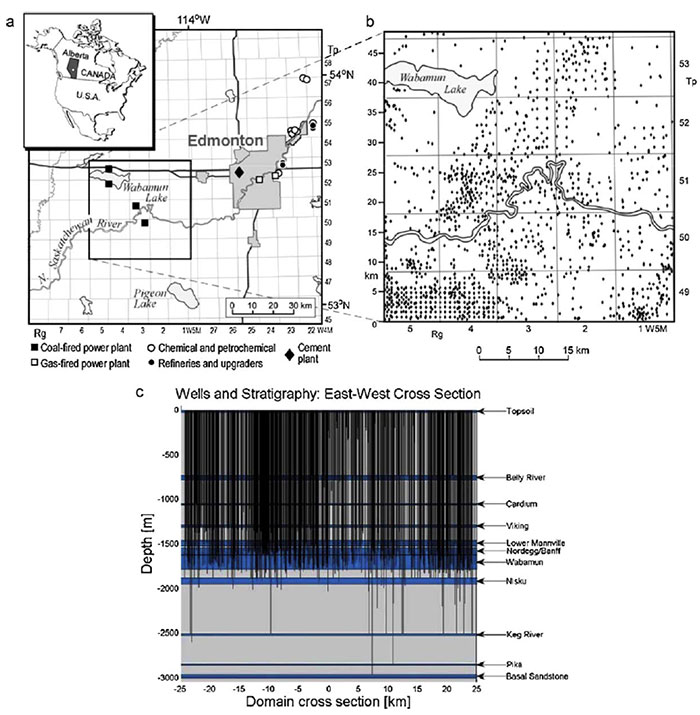
Subsequently, the Celia group combined the original modeling with the new data sets to produce quantitative estimates of expected leakage rates for a specific potential injection site in the Alberta Basin. The site is in the Wabamun Lake area, and the injection formation is the Nisku Formation (see Figure 2.1). The collective data from the measurement programs were used to define overall statistics for well permeabilities, and those statistics were applied to the old wells in the Wabamun Lake area. The model includes 11 permeable formations along the vertical direction, with a total of 1,146 old (potentially leaky) wells in an area of 2,500 square kilometers (see Figure 2.1). The efficient computational models developed earlier by the Celia team enabled the researchers to run 1,000 simulations of the problem, assigning different well permeability values based on statistics from the measured data sets. The mean leakage rate for the fraction of injected CO2 that reaches the shallow aquifers after 50 years of injection is less than 0.001%, and 95% of the results fall below 0.002%. The total amount of CO2 that leaks out of the injection formation, independent of whether it reaches the shallow zone, also stays well below 0.1% after 50 years. Moreover, the amount of brine that leaks is consistently much lower than the amount of CO2.
All results to date indicate that leakage from the Nisku Formation should be expected to be very low, assuming the properties of the old wells in this area can be estimated from the statistics derived from different sets of well data (which do not involve wells from Alberta). The amount of brine that leaks into shallow aquifers is much lower than the amount of CO2, indicating that shallow drinking water supplies should be safe from any significant leakage of CO2 or displaced brine. While a broader analysis using these leakage models is ongoing, the overall conclusion is not expected to change.
References
- Nordbotten, J., M.A. Celia, S. Bachu, and H.K. Dahle, 2005. Semianalytical Solution for CO2 Leakage through an Abandoned Well. Environ. Sci. Technol., 39(2): 602-611. doi:10.1021/es035338i.
- Nordbotten, J., M.A. Celia, and S. Bachu, 2005. Injection and Storage of CO2 in Deep Saline Aquifers: Analytical Solution for CO2 Plume Evolution during Injection. Transport Porous Med., 58(3): 339- 360. doi:10.1007/s11242-004-0670-9.
- Nordbotten, J.M., and M.A. Celia, 2006. Similarity Solutions for Fluid Injection into Confined Aquifers. J. Fluid Mech., 561: 307-327. http://dx.doi.org/10.1017/S0022112006000802.
- Nordbotten, J.M., D. Kavetski, M.A. Celia, and S. Bachu, 2009. Model for CO2 Leakage including Multiple Geological Layers and Multiple Leaky Wells. Environ. Sci. Technol., 43(3): 743-749. doi:10.1021/es801135v.
- Nordbotten, J.M., and M.A. Celia, 2012. Geological Storage of CO2: Modeling Approaches for Large-scale Simulation. Hoboken, NJ: John Wiley and Sons.
- Celia, M.A., and J.M. Nordbotten, 2009. Practical Modeling Approaches for Geological Storage of Carbon Dioxide. Ground Water, 47(5): 627-638. doi:10.1111/j.1745-6584.2009.00590.x.
- Celia, M.A., J.M. Nordbotten, B. Court, M. Dobossy, and S. Bachu, 2011. Field-scale Application of a Semi-analytical Model for Estimation of CO2 and Brine Leakage along Old Wells. Int. J. Greenhouse Gas Control, 5(2): 257-269. doi:10.1016/j.ijggc.2010.10.005.
- Celia, M.A., S. Bachu, J.M. Nordbotten, and K.W. Bandilla, 2015. Status of CO2 Storage in Deep Saline Aquifers with Emphasis on Modeling Approached and Practical Simulations. Water Resour. Res., 51(9): 6846-6892. doi:10.1002/2015WR017609.
- Bandilla, K., M.A. Celia, J.T. Birkholzer, A. Cihan, and E.C. Leister, 2015. Multi-phase Modeling of Geologic Carbon Sequestration in Saline Aquifers. Ground Water, 53(3): 362-277. doi:10.1111/ gwat.12315.
- Gasda, S.E., J.M. Nordbotten, and M.A. Celia, 2009. Vertical Equilibrium with Sub-scale Analytical Methods for Geological CO2 Sequestration. Computat. Geosci., 13(4): 469-481. doi:10.1007/s10596- 009-9138-x.
- Gasda, S.E., J.M. Nordbotten, and M.A. Celia, 2011. Vertically-averaged Approaches for CO2 Migration with Solubility Trapping. Water Resour. Res., 47(5): W05528. doi:10.1029/2010WR009075.
- Gasda, S.E., J.M. Nordbotten, and M.A. Celia, 2012. Application of Simplified Models to CO2 Migration and Immobilization in Large-scale Geological Systems. Int. J. Greenhouse Gas Control, 9: 72-84. doi:10.1016/j.ijggc.2012.03.001.
- Celia, M.A., J.M. Nordbotten, B. Court, M. Dobossy, and S. Bachu, 2011. Field-scale Application of a Semi-analytical Model for Estimation of CO2 and Brine Leakage along Old Wells. Int. J. Greenhouse Gas Control, 5(2): 257-269. doi:10.1016/j.ijggc.2010.10.005.
- Nogues, J.P., B. Court, M. Dobossy, J.M. Nordbotten, and M.A. Celia, 2012. A Methodology to Estimate Maximum Probable Leakage along Old Wells in a Geological Sequestration Operation. Int. J. Greenhouse Gas Control, 7: 39-47. doi:10.1016/j.ijggc.2011.12.003.
- Crow, W., J.W. Carey, S. Gasda, D.B. Williams, and M. Celia, 2010. Wellbore Integrity Analysis of a Natural CO2 Producer. Int. J. Greenhouse Gas Control, 49(2): 186-197. doi:10.1016/j.ijggc.2009.10.010.
- Crow, W., J.W. Carey, S. Gasda, D.B. Williams, and M. Celia, 2010. Wellbore Integrity Analysis of a Natural CO2 Producer. Int. J. Greenhouse Gas Control, 49(2): 186-197. doi:10.1016/j.ijggc.2009.10.010.
- Gasda, S.E., J.M. Nordbotten, and M.A. Celia, 2008. Determining Effective Wellbore Permeability from a Field Pressure Test: A Numerical Analysis of Detection Limits. Environ. Geol., 54(6): 1207- 1215. doi:10.1007/s00254-007-0903-7.
- Gasda, S.E., J.M. Nordbotten, and M.A. Celia, 2012. Application of Simplified Models to CO2 Migration and Immobilization in Large-scale Geological Systems. Int. J. Greenhouse Gas Control, 9: 72-84. doi:10.1016/j.ijggc.2012.03.001.
- Duguid, A., R. Butsch, J.W. Carey, M. Celia, N. Chuganov, S. Gasda, T.S. Ramakrishnan, V. Stamp, and J. Wang, 2013. Pre-injection Baseline Data Collection to Establish Existing Wellbore Leakage Properties. Energy Procedia, 37: 5661-5672. doi:10.1016/j.egypro.2013.06.488.
- Kang, M., E. Baik, A.R. Miller, K.W. Bandilla, and M.A. Celia, 2015. Effective Permeabilities of Abandoned Oil and Gas Wells: Analysis of Data from Pennsylvania. Environ. Sci. Technol., 49(7): 4757-4764. doi:10.1021/acs.est.5b00132.