

Principal Investigator

At a Glance
Building more energy-efficient systems depends on the ability to optimize and regulate the performance of energy-storing batteries. The Steingart group has developed a new type of zinc material that overcomes many of the limitations of zinc storage batteries. This material may be useful for long-term energy storage in grid-scale and electric vehicle applications.
Research Highlight
Zinc is a low-cost, abundant material, and its strong reducing potential combined with stability in water give it a high energy density. These properties have made zinc an excellent choice of anode material in a wide range of battery designs for more than 200 years. However, zinc also presents some challenges for use in a storage battery.
During charging, zinc undergoes morphological changes, and may produce dendrites—microscopic conductive fibers that can short-circuit a battery. Zinc also exhibits low utilization during discharge. Low utilization is related to a combination of corrosion and passivation effects: zinc oxide formed during standard operation and/or corrosion will block remaining reaction sites if not considered in the battery design.
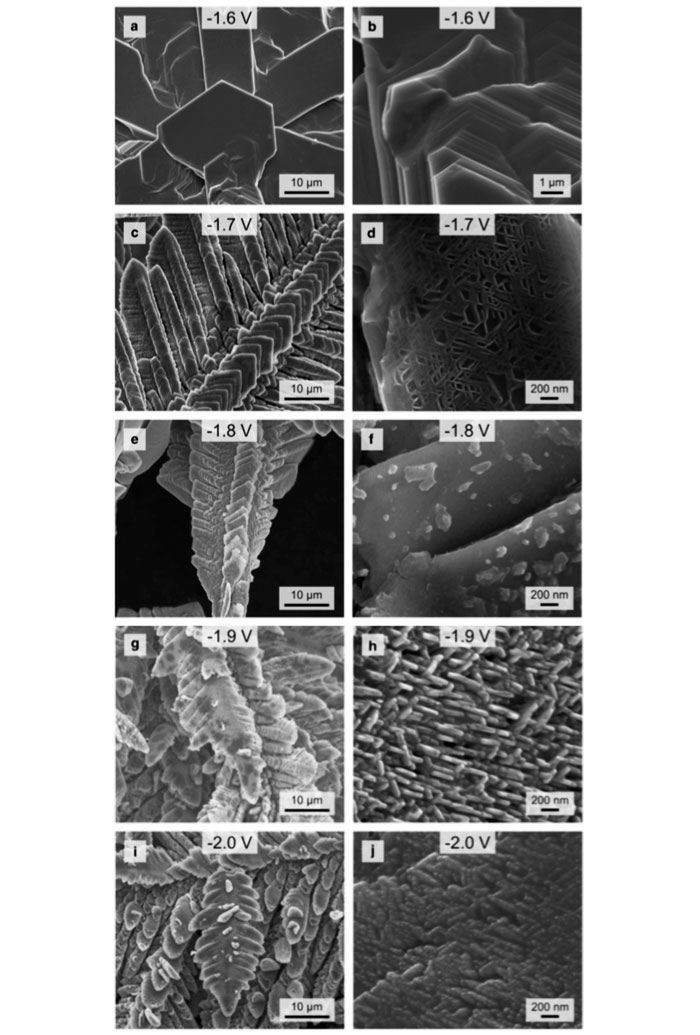
To overcome these challenges, the Steingart group has created a hyper-dendritic zinc morphology with a high surface area that allows for rapid discharge in a free-standing system with no binding material or conductive additives, while still maintaining significantly higher utilization levels than typical zinc morphologies. At rates of 2.5 amperes per gram of material, the high-density zinc has a utilization level approximately 50% higher than typical zinc granules or dust. Tuning the electrolyte with specific additives further increases the utilization level of the material at high-rate discharge by up to 30%.
Zinc has many favorable characteristics for large-scale energy storage: high volumetric energy density, low cost, low toxicity, global abundance, and chemical compatibility with water-based electrolytes. Silver-zinc batteries have been successfully used as primary and secondary cells in a range of demanding applications, including those requiring large scale, high power and high energy density. These include critical military applications, such as guidance systems for torpedoes and missiles.
However, zinc electrodes present some significant challenges, and anode failure is a key factor in the reduced cycle life of these batteries. These challenges include morphology changes and dendrite growth during deposition, which can lead to problems such as the short circuit of a cell, and poor utilization efficiencies during the discharge step, which is a dissolution reaction, arising mainly from corrosion and passivation effects. As such, typical zinc utilization levels are limited to 60% or lower. Careful engineering and materials science can extend the cycle life of the electrode; however, these issues still present a major limitation for secondary batteries using a zinc electrode.
Over the last year the Steingart group has furthered engineering of a zinc morphology formed in a counterintuitive manner, generating zinc that produces dendrites “on purpose.” The dendrites are about 30 nanometers long; at the length scales critical for batteries, they create reliable foams at the micron scale. Many properties of these foams are superior to those of standard zinc particles and plates—including energy utilization, power density, and cycle life. In the next year the Steingart group will further explore the fundamental basis for this improvement, and will work to build new types of batteries that take advantage of the hyper-dendritic zinc.
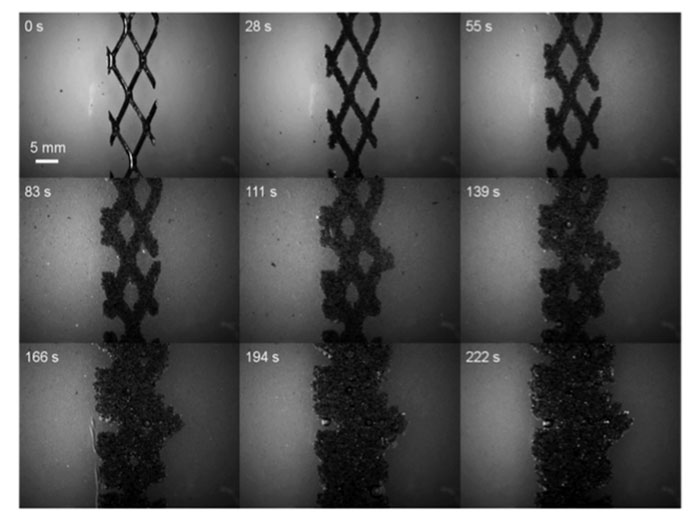
Such batteries can be operated and built in a variety ways. The way in which the battery is formed is counterintuitive, in that dendrites are grown, on purpose, so aggressively that the growth front becomes even and predictable at the micron scale even though it is rough at the nano scale. In previous work, the group also showed that short circuits in zinc batteries are not a safety concern, as the short-circuit product is simply zinc oxide. Because short circuits are no longer a concern, the battery may be designed to “short circuit” occasionally to regenerate.
If this design is successful, batteries will be able to hold more energy and last longer, with the compromise that the enhanced surface area my lead to more battery self-discharge due to corrosion, and that the structure is still dynamic and may have to be reformed occasionally. Some batteries utilizing hyper-dendritic zinc may be built for around $30 per kilowatt-hour. At such prices, the marginal cost of storage becomes reasonable for long-term (3- to 10-hour) power on a daily basis. Current batteries are designed such that round-trip efficiency is very high, but the cost is at least $150 per kilowatt-hour.